
Research Theme 2
Time and the end of life
Project outputs
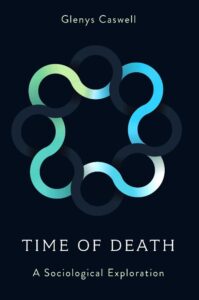
Addressing a gap in social science research to explore the meanings, understandings, and experiences of time at life’s most critical point, Time of Death takes a thoughtful sociological approach to questions about how humans use and experience time in relation to when someone dies. Considering temporal theories and drawing on a range of disciplines, Glenys Caswell discusses efforts to measure and record times of death, as well as the ways in which people who undergo bereavement experience time during that process.
Looking at the impact of digital technologies, the differences in interpretation of what counts as death in varied social contexts, assisted dying and temporal dissonance, and global cases of people dying alone, the author poses critical questions. To what extent is this measurement the province of the medical and legal professions and official state statistics? How accurate is this data and is there need for its collection? How does time in relation to death become fluid in a previously non-experienced way?
Investigating this conceptual focus and questioning what it can add to our knowledge of the human relationship with time, Caswell brings together studies on death and temporality to create a valuable resource for scholars across disciplines.
Add: For further information visit: https://www.emerald.com/insight/publication/doi/10.1108/9781804550052
Project 1
‘When someone dies: experiences and perspectives of bereaved people and professionals’. Funded by the British Academy. November 2019 to March 2021. The aim was to explore experiences and understandings about time of death with people who had been bereaved. It also aimed to explore experiences and understandings about time of death with professionals whose work brought them into contact with either people who are dying or dead bodies.
Overview of findings
Methods
Research data was collected by interviewing participants, either online or by phone.
Findings
1) Professional interviews
Five interviews were carried out with professionals. These were: an anatomical pathology technologist, working in a mortuary; a funeral director; a palliative care nurse working in a community setting; a butterfly volunteer working in a hospital setting to support dying people; a soul midwife (who was also a butterfly volunteer) who supported people towards, and at the end of, life.
One of the responsibilities which professionals have is record keeping, and ensuring that the data are available to be added to the national statistical data sets. Whenever someone dies it is necessary for their death to be certified by a doctor, prior to be registered. The doctor will record the time at which they certify the death, rather than the time at which the person died. This means that, should the person die during the evening and there be a delay in the doctor’s visit, the date on the death certificate may be the day after the death actually occurred. This is sometimes distressing for families, who may worry that their person had not been deceased when they were told it had occurred. It is also the case that when someone dies alone and their body is undiscovered for a period of time – long or short – their date of death will be recorded on their death certificate as the date on which they were found.
Those working with dying people noted how it happens that when a dying person is accompanied by their family, they will sometimes die when the family have left their bedside for a short time. There is a belief among some professionals that dying people have a measure of choice in when of they die, and they may wish to spare their family the sharpness of that moment.
2) Interviews with bereaved people
Seventeen people who had experienced bereavement took part in an interview. Each wished to speak about one particular experience of bereavement, although most also drew on previous experience. Unsurprisingly, people’s experiences differed. In terms of time, however, there were resonances between the ways in which participants experienced it. During the period when their person was dying, time as measured by the clock still existed, but it moved differently for bereaved participants. Some had been unaware of time’s passing, others felt the difference in how it passed, but they were all living outside normal time parameters. Time, for them, was effectively suspended in what could be described as an expanded present.
The moment of dying is important, and most participants wished to be with their dying person at that moment and to be aware of it. However, it was a moment which was within and was part of an expanded present, and this was made up of the period when their person was dying, the time at which they died and the immediate aftermath of the death. Time was suspended for the bereaved participants not so much in the sense that it stopped passing; they all knew that time continued to run, just as they all knew that their person had died; but for a period, time ceased to have relevance or importance. For this group of participants, the present expanded beyond a narrow ‘now’ to encompass just now and soon as well.
Project outputs
Conference presentations
Caswell, G. ‘It was time for him to go’: time as enacted social practice at the end of life. British Sociological Association conference 13/4/2021 – 15/4/2021. Online
Caswell, G. ‘When does a person die? Exploring diverse approaches to time of death’. 15th International conference on the social context of death, dying and disposal. 1/9/2021 – 4/9/2021. Manchester Metropolitan University, online.
Publications
Caswell, G. & Wilson, E. (2024) The impact of home mechanical ventilation on the time and manner of death for those with Motor Neurone Disease (MND): a qualitative study of bereaved family members. Social Science & Medicine. 360. Online first https://doi.org/10.1016/j.socscimed.2024.117345
Caswell, G. (2024) ‘Sociological insights into post-death time experiences’. In Mallon, S. & Towers, L. (eds.) Death, Dying and Bereavement: New Sociological Perspectives. Routledge/BSA. Pp. 40-51.
I am a member of several organisations:


